Mock Test — IELTS Listening
IELTS LISTENING AUDIO STREAM
Section 1: Beechen FestivalQuestions 1–6
Complete the table below.
Write ONE WORD AND/OR A NUMBER for each answer.
Beechen Festival
Questions 7–10
Complete the notes below.
Write ONE WORD AND/OR A NUMBER for each answer.
• This year, activities end by (7) p.m.
• There won't be any (8) in the town centre this year.
• The festival's web address is www. (9) .com.
• Festival organisers would like to receive (10) online.
Mock Test — IELTS Reading Passage 1
The development of the silk industry
You should spend about 20 minutes on Questions 1–13 which are based on Reading Passage 1.
Silk, a natural fibre produced by a particular worm called a silkworm, has been used in clothing for many centuries.
When silk was first discovered in China over 4,500 years ago, it was reserved exclusively for the use of the emperor, his close relations and the very highest of his dignitaries. Within the palace, the emperor is believed to have worn a robe of white silk; outside, his principal wife, and the heir to the throne wore yellow, the colour of the earth.
Gradually silk came into more general use, and the various classes of Chinese society began wearing tunics of silk. As well as being used for clothing and decoration, silk was quite quickly put to industrial use, and rapidly became one of the principal elements of the Chinese economy. It was used in the production of musical instruments, as string for fishing, and even as the world's first luxury paper. Eventually even the common people were able to wear garments of silk.
During the Han dynasty (206 BC–220 AD), silk ceased to be a mere fabric and became a form of currency. Farmers paid their taxes in grain and silk, and silk was used to pay civil servants and to reward subjects for outstanding services. Values were calculated in lengths of silk as they had previously been calculated in weight of gold. Before long, silk became a currency used in trade with foreign countries, which continued into the Tang dynasty (616–907 AD). It is possible that this added importance was the result of a major increase in production. Silk also found its way so thoroughly into the Chinese language that 230 of the 5,000 most common characters of Mandarin* have 'silk' as their key component. Silk became a precious commodity, highly sought after by other countries from an early date, and it is believed that the silk trade actually existed before the Silk Road† was officially opened in the second century BC.
An Egyptian mummy with a silk thread in her hair, dating from 1070 BC, has been discovered in the village of Deir el Medina near the Valley of the Kings, and is probably the earliest evidence of the silk trade. During the second century BC, the Chinese emperor Han Wu Di's ambassadors travelled as far west as Persia and Mesopotamia, bearing gifts including silks. A range of important finds of Chinese silks have also been made along the Silk Road. One of the most dramatic of these finds was some Tang silk discovered in 1900. It is believed that around 1015 AD Buddhist monks, possibly alarmed by the threat of invasion by Tibetan people, had sealed more than ten thousand manuscripts and silk paintings, silk banners and textiles in caves near Dunhuang, a trading station on the Silk Road in north-west China.
Some historians believe the first Europeans to set eyes upon the fabulous fabric were the Roman legions of Marcus Licinius Crassus, Governor of Syria. According to certain accounts of the period, at an important battle near the Euphrates River in 53 BC, the Roman soldiers were so startled by the bright silken banners of the enemy that they fled in panic. Yet, within decades Chinese silks were widely worn by the rich and noble families of Rome. The Roman Emperor Heliogabalus (218–222 AD) wore nothing but silk. By 380 AD, the Roman historian Marcellinnus Ammianus reported that the use of silk, which was one confined to the nobility, has now spread to all classes without distinction — even to the lowest. The desire for silk continued to increase over the centuries. Despite this demand, the price of silk remained very high.
In spite of their secrecy about production methods, the Chinese eventually lost their monopoly on silk production. Knowledge of silk production methods reached Korea around 200 BC, when waves of Chinese immigrants arrived there. Shortly after 300 AD, it travelled westward, and the cultivation of the silkworm was established in India.
Around 550 AD silk production reached the Middle East. Records indicate that two monks from Constantinople (modern-day Istanbul), capital of the Byzantine Empire, appeared at their emperor's court with silkworm eggs which they had obtained secretly, and hidden in their hollow bamboo walking sticks. Under their supervision the eggs hatched into worms, and the worms spun silk threads. Byzantium was in the silk business at last. The Byzantine church and state created imperial workshops, monopolising production and keeping the secret to themselves. This allowed a silk industry to be established, undercutting the market for ordinary-grade Chinese silk. However, high quality silk textiles, woven in China especially for the Middle Eastern market, continued to achieve high prices in the West, and trade along the Silk Road continued as before. By the sixth century the Persians, too, had mastered the art of silk weaving, developing their own rich patterns and techniques. But it wasn't until the 13th century that Italy began silk production, with the introduction of 2,000 skilled silk weavers from Constantinople. Eventually, silk production became widespread throughout Europe.
World silk production has approximately doubled during the last 30 years in spite of man-made fibres replacing certain uses of silk. Before this period, China and Japan were the two main producers, together manufacturing more than 50 per cent of world production each year. After the late 1970s, however, China dramatically increased its silk production, and once again became the world's leading producer.
* A group of related Chinese dialects which have been recognised as the 'national language' since the early 20th century
† An ancient trade route between China and the Mediterranean Sea
Questions 1–7
Complete the notes below.
Choose ONE WORD ONLY from the passage for each answer.
Chinese silk
• at first, silk only available to Chinese of high rank
• emperor wore (1) silk indoors
• silk items included parts of musical instruments, fishing strings and (2)
• silk was used as payment of (3) as well as for wages and rewards
• silk replaced (4) as a unit of value
• silk soon used as payment in (5) trade
• hair of a (6) contained silk
• gifts of silk were presented by Chinese ambassadors
• silk objects were hidden inside (7)
Questions 8–13
Do the following statements agree with the information given in Reading Passage 1?
Write TRUE, FALSE, or NOT GIVEN.
8. Their first sight of silk created fear among Roman soldiers.
9. The quality of Chinese silk imported by the early Romans varied widely.
10. The Byzantine emperor first acquired silkworm eggs from the Chinese emperor.
11. The price of high-grade Chinese silk fell due to competition from Middle-Eastern producers.
12. Silk was produced in the Middle East several centuries before it was produced in Europe.
13. Global silk production has declined in recent years.
Mock Test — IELTS Writing (Task 1 & Task 2)
WRITING TASK 1 (20 phút — Tối thiểu 150 từ)
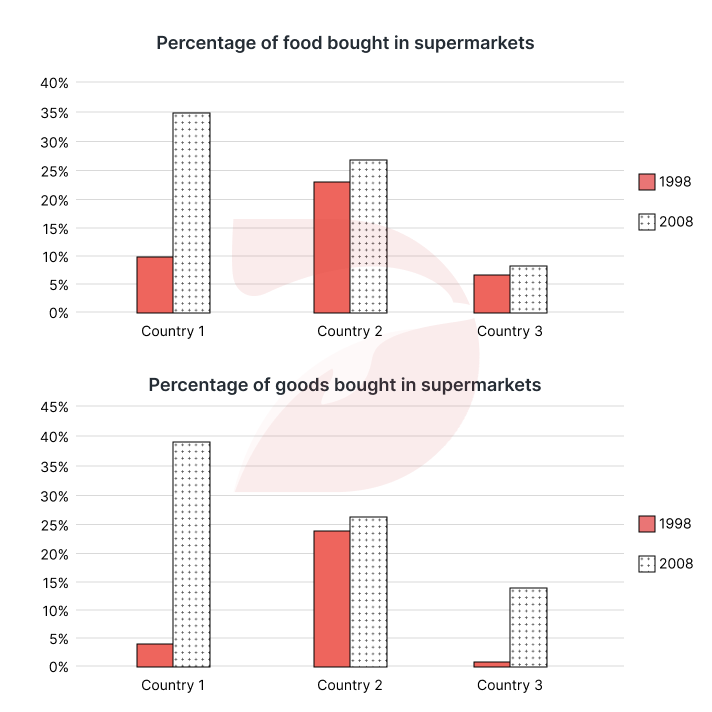
The charts below show the percentages of food and goods bought in supermarkets in European countries in 1998 and 2008. Summarise the information by selecting and reporting the main features, and make comparisons where relevant.
WRITING TASK 2 (40 phút — Tối thiểu 250 từ)
Every day, millions of tons of food are wasted all over the world. Why do you think this is happening? And how can we solve this problem? Give reasons for your answer and include any relevant examples from your own knowledge or experience. Write at least 250 words.
Mock Test — IELTS Speaking (Part 1, 2 & 3)
Đọc lần lượt đề bài 3 phần bên dưới, sau đó chọn 1 trong 2 phương thức nộp bài ở bảng điều khiển cuối trang.
PART 1 — Introduction & General Questions
Thời lượng: 4–5 phút1. Which town or city do you live in now?
2. Are you planning to do anything special next weekend? (Why / Why not?)
3. Do you have breakfast everyday?
4. Do you spend your evenings in the same way on weekdays and at weekends? (Why / Why not?)
PART 2 — Individual Long Turn (Cue Card)
Chuẩn bị: 1 phút · Nói: 1–2 phútYou should say:
- What it was
- Who you did it with
- How long it took you to do this
- And explain why you did it with one or more people.
PART 3 — Two-way Discussion
Thời lượng: 4–5 phút1. What kinds of jobs need people to work in a team?
2. How do you get along with your neighbors?
3. What can parents do with their children to make them happy?
4. How can children improve their social skills?
Nộp Bài Thu Âm Toàn Bộ 3 Phần (Part 1, 2, 3)
Bạn có thể chọn thu âm trực tiếp trên website HOẶC dán link Google Drive nếu đã có file thu âm sẵn.
Bấm nút tròn đỏ để bắt đầu đọc lần lượt câu trả lời cho Part 1, Part 2 và Part 3. Bấm lại để dừng và nghe lại.
Nếu bạn đã thu âm bằng điện thoại hoặc máy tính ngoài, hãy tải file lên Google Drive (chọn quyền "Bất kỳ ai có liên kết") rồi dán link bên dưới: